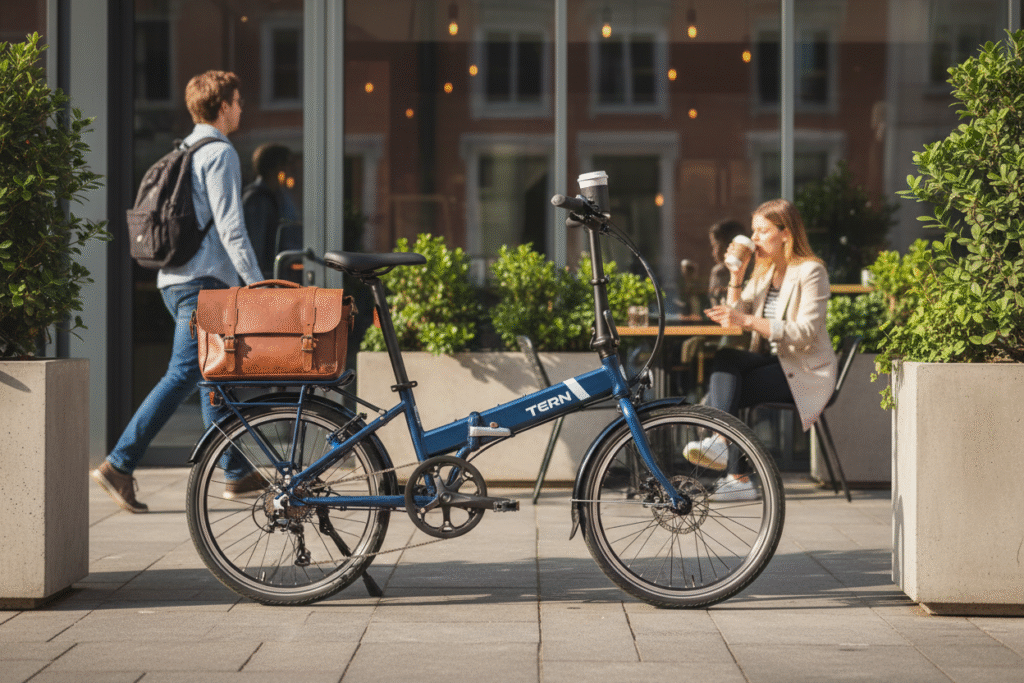
Tern has become one of the most influential names in modern urban cycling—especially for riders who want folding convenience without giving up the speed, stability, or capability of a “real” bike. With an engineering-first mindset, larger wheel options, and platforms designed for serious cargo hauling and fast commuting, Tern sits at the intersection of utility and sporty performance. In 2026, the brand continues to grow its range with more refined folding hardware, advanced e-cargo designs, and commuter-focused models that make day-to-day city life easier.
Where Brompton dominates the ultra-compact end of the market, Tern leads the performance-focused folding segment—offering stiffer frames, sharper handling, bigger wheels, and setups that work as well for weekend touring as they do for grocery runs. This brand review looks at Tern’s full identity: history, engineering approach, product families, ride feel, ideal users, strengths, weaknesses, competition, pricing, and the type of rider Tern really serves.
Brand Overview
Founded: 2011
Headquarters: Taipei, Taiwan
Key Categories: Performance folding bikes, cargo and utility bikes, electric folding bikes, e-cargo bikes, commuting platforms
Notable Models: Verge, Link, BYB, Vektron, HSD, GSD, Quick Haul, Short Haul
Market Segment: Performance folding, urban mobility, cargo/utility, premium e-bike systems
Tern positions itself as an engineering-driven urban mobility brand. Its bikes fold smaller than standard full-size bikes, but are built to feel as close to a conventional bicycle as possible—thanks to stiff frames, larger wheels, and highly adjustable cockpits. The electric lineup is especially strong in the cargo and family segment, where Tern has become a reference brand.
History and Legacy
Tern was started by a group of industry veterans, including people with deep experience in the folding bike category. From day one, the mission was clear: build folding bikes that ride better, go faster, and carry more than the traditional compact folders that prioritized small size above all else.
The Verge series was one of Tern’s first breakout platforms—a fast, sporty folding bike with sharper geometry and a more road-like feel. As cities grew denser and e-bikes became mainstream, Tern expanded into compact cargo with models like the GSD and HSD, proving that a relatively small bike could still replace a car for many households.
Today, Tern is widely regarded as one of the most forward-looking brands in urban cycling—not because of wild concepts, but because they consistently refine the details that matter in real daily use.
Design Philosophy
Tern’s design work revolves around four themes: ride quality, smart folding, utility, and adjustability.
1. Ride Quality First
Every Tern platform starts from the premise that it must ride like a proper bike, not a compromise. To get there, Tern emphasizes:
- Short, stiff frames with carefully engineered tube shapes
- Larger wheel sizes (20″, 24″, or 26″ depending on model)
- Overbuilt joints and hinge mechanisms
- Wide adjustment ranges in stem and seatpost to achieve a proper fit
This approach delivers stable handling, efficient power transfer, and comfort over longer distances—traits not always associated with folding bikes.
2. Smart Folding, Not Minimalist Folding
Instead of chasing the tiniest possible fold, Tern aims for a usable fold that doesn’t compromise ride feel and durability.
- Folded size is larger than ultra-compact brands
- Hinges and latches are heavier-duty
- Out-of-saddle efforts feel secure rather than flexy
This appeals to riders who care more about how the bike rides and carries than whether it fits under every café table.
3. Utility & Cargo Capability
Tern’s product range leans heavily into real transport:
- Frames designed around heavy-duty racks
- High maximum load ratings
- Geometry tuned for stability under cargo and child seats
The GSD and HSD in particular are benchmarks for compact e-cargo bikes, capable of replacing many car trips, especially for families and urban professionals.
4. Modularity & Adjustability
Most Tern frames are built to evolve with the rider:
- Adjustable cockpits to fit different heights or riding styles
- Compatibility with racks, baskets, panniers, and child seats
- Front and rear load-carrying systems
That modularity makes it practical to keep a Tern through life changes—new job, new city, new kid—without needing a whole new bike.
Technology & Innovation
Folding Mechanisms
Tern employs several hinge systems across the lineup, all designed to maximize stiffness and long-term reliability:
- Physis 3D Handlepost: A one-piece forged handlepost that dramatically increases front-end stiffness and steering precision.
- OCL Joint: A large, precision-machined frame hinge designed to resist flex while staying easy to operate.
- Double-Lock Systems: Redundant catch systems to prevent accidental opening and extend hinge life.
The result is a folding platform that feels closer to a conventional bike than most compact folders.
Wheel Size Options
Tern stands out by offering multiple wheel formats, each tailored to a specific job:
- 20″ (406 & 451): Quick acceleration and nimble handling, ideal for folding commuters and sporty models like Verge.
- 24″: Smoother ride and better obstacle rollover, excellent for touring and cargo use.
- 26″: Full-size feel and stability, primarily on cargo and utility platforms.
This flexibility allows Tern to tune each bike around its intended use rather than forcing everything around a single wheel standard.
Electric Systems
For e-bikes, Tern leans on proven mid-drive systems:
- Bosch and Shimano motors
- Internal integration of batteries where possible
- Tuning focused on smooth, predictable power rather than brute torque
Tern’s e-bikes typically feature:
- Extended range options (dual batteries on some cargo platforms)
- Cargo-rated frames
- Strong disc brakes
- Integrated lighting and wiring
They’re built to handle real work, not just light recreational rides.
Cargo Engineering
The GSD is the clearest example of Tern’s cargo thinking:
- Dual-battery capability on many trims
- Extra-strong rear rack that accepts multiple child seats or large panniers
- High gross vehicle weight ratings
- Low standover and low center of gravity for stability when loaded
It’s a bike that feels composed even when loaded with kids, groceries, and bags at the same time.
Accessory Ecosystem
Tern backs its frames with a large catalog of custom-fit accessories:
- Front and rear racks
- Panniers, baskets, and cargo bags
- Child-carry setups
- Weather protection and covers
Because these accessories are designed around specific frames, they fit cleanly and do not feel like afterthoughts.
Popular Models
Verge Series
Sport-oriented folding bikes for riders who still care about pace and responsiveness.
- Aggressive geometry
- Lightweight builds
- Great for riders who want something that feels close to a road bike but can still fold for transit or storage.
Link Series
Everyday folding bikes aimed at durability and practicality.
- Robust frames and hinges
- Comfortable geometry
- Ideal for daily commutes, short trips, and multi-modal use.
BYB
Tern’s answer for riders who need a more compact fold without giving up stability.
- Smaller folded package than Verge or Link
- Still rides with more stiffness than many ultra-compact competitors
- Suited to riders who combine trains, buses, and limited home storage.
Vektron (Electric)
A folding e-bike built around Bosch mid-drive power.
- Stable handling and strong hill-climbing capability
- Ideal for urban riders who need the flexibility of a folder with the assistance of a full e-bike.
HSD (Electric Compact Cargo)
A compact cargo platform for one adult rider plus cargo or a child.
- Shorter overall length than many cargo bikes
- High load rating and integrated rear rack
- Easy to store and maneuver despite its capacity.
GSD (Electric Longtail Cargo)
One of the most capable compact e-cargo bikes available.
- Longtail layout with substantial rear capacity
- Designed to carry two kids, heavy loads, or a mix of both
- A true car-replacement platform for many urban households.
Short Haul & Quick Haul
More budget-accessible utility bikes with a focus on practicality.
- Lower pricing compared to GSD/HSD
- Still offer meaningful cargo capability and everyday comfort
- Good entry point for riders exploring cargo and utility cycling.
Performance and Ride Quality
Handling
Tern’s bikes feel planted and predictable, even at higher speeds, thanks to stiff frames and carefully chosen wheelbases. On cargo models, low centers of gravity and well-tuned geometry help the bike remain calm under load.
Comfort
Adjustable cockpits make it easy for different riders to find a comfortable position without needing a custom fit. Combined with larger wheels and thoughtful tire choices, Tern bikes handle poor pavement, curbs, and mixed surfaces better than most folding platforms.
Acceleration & Efficiency
Compared with small-wheel, ultra-compact competitors, Tern’s bikes accelerate more naturally and maintain speed more efficiently. This is particularly noticeable on sporty models like the Verge and on longer commutes.
Load Capacity
On the cargo side, the HSD, GSD, and Haul models are built to handle serious weight. With proper setup, these bikes remain stable when loaded with kids, panniers, and front cargo, making them genuine tools for daily logistics.
Target Audience
| Rider Type | Why Tern Fits |
|---|---|
| Urban Commuters | Fast, stiff folding bikes that hold up to daily use |
| E-Bike Riders | Bosch-powered platforms with solid range and reliability |
| Families | GSD and HSD excel at carrying kids and gear |
| Delivery / Utility Riders | High payload limits and robust frames |
| Multi-Modal Commuters | BYB and Link make train/bus/bike combinations workable |
| Adventure Riders | 24″ and 26″ wheel options suit touring and light bikepacking |
Strengths and Weaknesses
Strengths
- Ride quality that rivals non-folding bikes
- Strong e-bike and cargo offerings
- Stiff frames and precise handling
- High load ratings and well-integrated accessories
- Use of premium electric systems like Bosch and Shimano
- More performance-focused than many folding competitors
Weaknesses
- Folded size is larger than ultra-compact brands
- Pricing on electric and cargo models is firmly in the premium bracket
- Heavier weights due to reinforced frames and hardware
- Less suited to riders whose top priority is minimal folded size or ultralight weight
Comparison & Market Position
| Brand | Focus | Key Advantage | Drawback |
|---|---|---|---|
| Tern | Performance folding & cargo | Stiff frames, strong ride feel, e-cargo depth | Larger folded size than ultra-compact bikes |
| Brompton | Ultra-compact folding | Smallest fold, unmatched portability | Less sporty ride and lower cargo capacity |
| Dahon | Budget-friendly folding bikes | Lower entry prices | Less stiffness, refinement, and durability |
Tern sits in the performance and utility corner of the folding space. If you care most about how the bike rides and what it can carry—rather than the tiniest possible package—Tern is often the leading choice.
Pricing and Value
| Category | Price Range | Comment |
|---|---|---|
| Entry Folding (Link, BYB) | Mid-range | Strong value for daily commuters |
| Performance Folding (Verge) | Upper mid-range | Sporty geometry and higher-end components |
| Electric Folding (Vektron) | Premium | Bosch systems with high build quality |
| Cargo (HSD, GSD, Haul series) | High-end | Designed as serious car-replacement platforms |
Tern is not a budget brand, but pricing reflects the level of engineering, component quality, and long-term durability built into the bikes.
Final Thoughts on Tern
Tern is a natural fit for riders who want more than just a compact fold. Their bikes are built for people who ride a lot, carry real loads, and expect their bike to feel stable, fast, and trustworthy day after day. From aggressive folding commuters to compact e-cargo haulers, Tern has shaped itself into a go-to name for performance-focused urban mobility.
If your priorities lean toward ride quality, cargo capability, and solid e-bike systems—and you still need something that can fold for storage or transit—Tern is one of the most compelling options on the market in 2026.
FAQ
Are Tern bikes good for daily commuting?
Yes. Tern designs many of its bikes specifically for urban commuting, offering stable handling, strong component choices, and reliable folding and cargo systems.
Is Tern better than Brompton?
Neither brand is universally “better.” Brompton is best for ultra-compact portability, while Tern excels in ride quality, stiffness, electric options, and cargo capability.
Are Tern electric bikes reliable?
Yes. Tern uses Bosch and Shimano mid-drive systems—two of the most proven motor platforms available—paired with reinforced frames built for long-term durability.
Can Tern bikes carry heavy loads?
Many Tern models, especially the GSD and HSD, are built for serious hauling. They support child seats, groceries, panniers, and loads that approach compact-cargo-bike territory.
Do Tern bikes fold as small as Brompton?
No. Tern prioritizes stiffness and ride quality, so their fold is larger. Riders who need the smallest possible fold should consider Brompton; those who want full-size performance lean toward Tern.
Are Tern bikes good for long-distance riding?
Yes. Tern’s geometry, wheel size options, and cockpit adjustability make them comfortable for medium-to-long-distance commuting or light touring.
How long do Tern bikes last?
With regular maintenance, Tern bikes can last many years. Their frames are overbuilt for stiffness and durability, and components are easily serviceable.
Related Content:
- Best Folding E-Bikes
- Best Road Bikes Guide
- Xtracycle Bikes Review
- Yuba Bikes Review
- Best E-Bike Brands Guide
Why Trust This Review?
BestBikeBrands is built by lifelong cyclists with decades of real-world experience — in the shop, on the trail, and behind the wrench. Our goal is simple: to help riders choose the best bikes and gear with confidence, backed by expert insights and hands-on testing. Learn more about us →