Germany’s Greenest Outdoor Brand—and Ortlieb’s Closest Rival
Among European cycling and outdoor equipment manufacturers, Vaude occupies a distinct position. While often compared directly to Ortlieb for waterproof panniers and bikepacking gear, Vaude has built a parallel reputation based on a different emphasis: sustainability, ethical production, and lighter-weight construction, paired with solid German engineering.
Founded in 1974, Vaude has grown from a small alpine outfitter into one of Europe’s most comprehensive cycling and outdoor brands. In 2026, it is widely regarded as the industry reference for environmentally responsible manufacturing, while still delivering equipment capable of long-distance touring, daily commuting, and multi-day bikepacking.
This review examines Vaude’s history, materials, design philosophy, core product lines, and real-world performance, with a focus on how the brand compares to more durability-first competitors.
Brand background and structure
Vaude was founded by Albrecht von Dewitz in Tettnang, Germany, near Lake Constance—a region with a long tradition of outdoor equipment manufacturing. From its earliest years, the company focused on mountaineering and trekking, expanding into cycling as touring and bike travel grew in popularity across Europe.
Key characteristics as of 2026:
- Family-owned, led by Antje von Dewitz (founder’s daughter)
- Headquarters and primary development in Germany
- Climate-neutral operations since 2012
- Extensive third-party environmental and labor certifications
- Broad product portfolio covering cycling, hiking, and alpine use
Vaude’s identity is closely tied to its corporate stance on sustainability. Unlike brands that treat environmental responsibility as a marketing layer, Vaude integrates it into sourcing, manufacturing, logistics, and product design.
Design philosophy: sustainability as a constraint, not an add-on
Vaude’s design process begins with environmental limits rather than purely performance-driven targets. This approach shapes everything from fabric selection to construction methods.
Core principles include:
- Avoidance of PVC wherever possible
- Preference for recycled and certified materials
- Repairability and long service life
- Functional, not trend-driven, feature sets
This philosophy results in products that are slightly lighter and more flexible than traditional “expedition-grade” gear, while still meeting the needs of most touring and commuting riders.
Materials and construction
Vaude’s construction quality is high, but its priorities differ from brands that focus on maximum abrasion resistance above all else.
Fabrics
Most Vaude cycling bags use polyester or nylon base fabrics derived partially or entirely from recycled PET bottles. These fabrics are coated with polyurethane (PU) laminates rather than PVC.
Implications:
- Reduced environmental impact
- Lower material stiffness
- Slightly lower abrasion resistance compared to heavy PVC tarpaulin
- Improved packability and comfort
Seam construction
Depending on the product line, Vaude uses:
- Welded seams for fully waterproof models
- Taped or sealed stitched seams for water-resistant designs
This allows Vaude to offer multiple waterproof tiers rather than a single “all-or-nothing” approach.
Certifications
Vaude is one of the few cycling brands whose products regularly carry:
- Bluesign® certification
- EU Ecolabel approval
- Fair Wear Foundation status
These certifications impose constraints on chemical use, labor conditions, and supply-chain transparency.
Mounting systems and on-bike stability
Vaude’s primary pannier attachment system is QMR 2.0 (Quick Mount Release).
Characteristics:
- Tool-free hook adjustment
- Lockable release lever for security
- Compatibility with common rack diameters
- Stable under touring loads
While similar in concept to Ortlieb’s QL systems, QMR emphasizes ease of adjustment and security rather than absolute mechanical simplicity. In practice, stability is comparable for commuting and touring use.
Bikepacking bags rely on reinforced straps and anti-slip panels rather than hard mounting hardware. This favors lighter weight and flexibility but can allow slightly more movement under aggressive off-road riding compared to the stiffest competitors.
Product range overview
Vaude’s cycling catalog is broader than most competitors, covering commuting, touring, gravel, and bikepacking without fragmenting into niche sub-brands.
Waterproof panniers (Aqua line)
The Aqua Back and Aqua Front panniers are Vaude’s direct equivalents to classic touring panniers.
Key traits:
- Fully waterproof roll-top construction
- Welded seams
- QMR 2.0 mounting
- Internal organization pockets
Compared to heavier-duty panniers, Aqua models trade some abrasion resistance for lower weight and better internal usability.
Touring and expedition systems
Road Master and Discover series products sit between full waterproof and modular touring gear.
Features:
- Hybrid closure systems
- Optional rain covers
- More complex internal layouts
- Compatibility with front and rear racks
These systems suit riders who prioritize organization and versatility over absolute waterproof redundancy.
Bikepacking systems
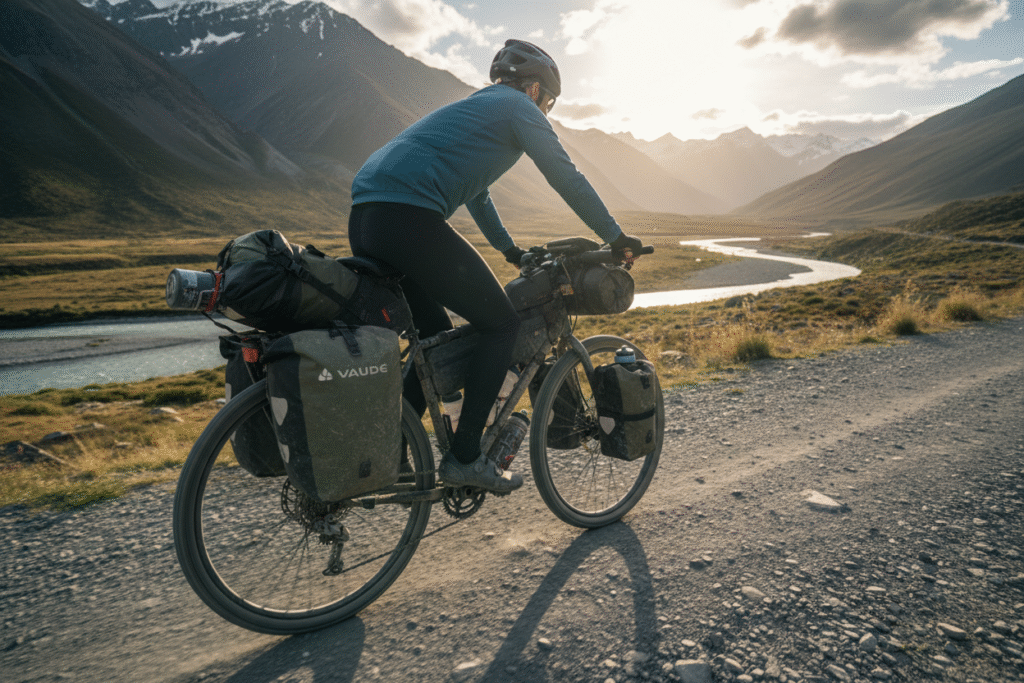
Vaude offers a complete modular bikepacking setup including:
- Handlebar rolls
- Seat packs
- Frame bags
- Top tube bags
These products emphasize:
- Lightweight materials
- Compressibility
- Stability on mixed terrain
They are well suited to gravel and moderate off-road routes, though not the most abrasion-resistant option for extended singletrack abuse.
Urban and commuter bags
Vaude’s commuter-oriented products include panniers, backpacks, and hybrid designs that convert between modes.
Notable attributes:
- Laptop protection
- Reflective detailing integrated into fabric
- Comfortable harness systems for off-bike use
This category is one of Vaude’s strongest differentiators from more touring-focused brands.
Waterproof performance in real use
Vaude products span multiple levels of weather protection.
- Aqua line: fully waterproof in sustained rain
- Hybrid lines: water-resistant, often with additional covers
- Urban packs: waterproof shells with organized interiors
In prolonged heavy rain, Aqua panniers perform reliably. Hybrid designs may allow minor moisture ingress through zippers or flap closures under extreme conditions. This is a known trade-off rather than a defect.
Vaude does not typically claim submersion resistance for most products, focusing instead on realistic riding conditions.
Comfort and off-bike usability
Vaude places more emphasis on carrying comfort than many pannier-focused brands.
Advantages:
- Ventilated back panels on backpacks
- Ergonomic shoulder straps
- Balanced load distribution when walking
Panniers convert easily into shoulder bags or briefcases, making them particularly suitable for commuting and mixed-mode travel.
Durability and service life
Vaude products are durable, but not designed to be indestructible.
Observed characteristics:
- Long service life with normal touring and commuting use
- Softer fabrics show wear sooner than heavy PVC tarpaulin
- Hardware and straps are replaceable
- Repairs are supported through dedicated service centers
For riders regularly scraping bags against rocks or loading extreme weights, heavier alternatives may last longer. For most use cases, Vaude durability is more than sufficient.
Sustainability and ethical production
Sustainability is Vaude’s most defining attribute.
Key initiatives:
- Climate-neutral operations for over a decade
- Extensive use of recycled materials
- Strict chemical controls
- Transparent labor practices
- On-site repair services
Rather than relying on offsets alone, Vaude focuses on reducing emissions and waste within its production chain.
Pricing and value
Vaude products are positioned slightly below premium “bombproof” brands in price.
General observations:
- Typically 10–15% less expensive than comparable top-tier alternatives
- Higher cost than entry-level panniers
- Strong value when sustainability and comfort are priorities
Long-term value depends on use intensity. Riders who replace gear infrequently and value lighter weight often find Vaude a better fit.
Strengths and limitations
Strengths
- Industry-leading sustainability credentials
- Lightweight and flexible construction
- Excellent comfort for off-bike carrying
- Broad and cohesive product ecosystem
- Competitive pricing for premium gear
Limitations
- Slightly lower abrasion resistance than the most rugged alternatives
- Some hybrid designs rely on zippers
- Availability varies by region outside Europe
Where Vaude fits best
Vaude is particularly well suited for:
- Commuters riding in wet climates
- Touring riders prioritizing weight and comfort
- Environmentally conscious cyclists
- Riders who frequently carry bags off the bike
It may be less ideal for:
- Ultra-heavy expedition touring
- Riders seeking maximum abrasion resistance
- Minimalist bikepacking in extreme terrain
Closing Thoughts on Vaude
Vaude’s position in 2026 is clear. It is not attempting to outdo every competitor on raw durability alone. Instead, it offers a carefully balanced alternative—one that prioritizes environmental responsibility, usability, and thoughtful engineering. For riders who want reliable waterproof gear while minimizing environmental impact, Vaude remains one of the strongest and most credible choices available.
FAQ — Vaude Brand Review
Is Vaude as waterproof as Ortlieb?
Almost. Vaude’s Aqua Line panniers are fully waterproof, though Ortlieb’s RF-welded seams provide slightly higher submersion protection.
Is Vaude a sustainable brand?
Yes. Vaude is climate-neutral, PVC-free, and certified by Bluesign® and Fair Wear.
Are Vaude panniers compatible with all racks?
Yes. The QMR 2.0 system adjusts to nearly any rack diameter.
How long do Vaude panniers last?
Typically 8–12 years with proper maintenance. Replacement parts are available directly from Vaude.
Where is Vaude made?
Most gear is made in Vaude’s climate-neutral facility in Germany, with select lines assembled in Vietnam under fair-trade supervision.
Related Content:
- Best Waterproof Bike Bags & Panniers
- Best Bikepacking Bags
- Ortlieb Brand Review
- Topeak Brand Review
- Ortlieb vs Vaude Comparison
Why Trust This Review?
BestBikeBrands is built by lifelong cyclists with decades of real-world experience — in the shop, on the trail, and behind the wrench. Our goal is simple: to help riders choose the best bikes and gear with confidence, backed by expert insights and hands-on testing. Learn more about us →