Pedro’s is a long-established maintenance brand with two defining traits: shop-grade durability in its tools and an unusually consistent emphasis on lower-toxicity, biodegradable chemistry in its cleaners and lubricants. Many companies sell “bike care” products. Pedro’s built its identity around the idea that routine maintenance should be effective without relying on harsh solvents, and that the tools used for that work should survive daily use rather than occasional garage sessions.
By 2026, Pedro’s occupies a stable position in workshops and home setups. Its bright yellow-handled tools are common in service bays, and its cleaners and lubricants are frequently chosen by riders who want products that rinse and dispose more cleanly than traditional petroleum-heavy formulations. The catalog is not as broad as the largest tool-only brands, but it covers the tasks most riders and mechanics do regularly: drivetrain cleaning and lubrication, basic hand tools, torque, tire service, and compact kits for travel and home benches.
This review summarizes Pedro’s background, product approach, and the categories where it tends to fit well. It also identifies the practical limitations that matter when deciding between Pedro’s and other common maintenance brands.
Brand snapshot
- Founded: 1989
- Headquarters: Stoughton, Massachusetts, USA
- Primary categories: Hand tools, tool kits, repair stands (select models), brushes, cleaners, degreasers, lubricants
- Typical users: Bike shops, mobile mechanics, team support, home mechanics
- Common purchasing pattern: Tools bought as long-term shop items; chemicals bought as recurring consumables
Pedro’s product range is organized more like a workshop ecosystem than a lifestyle catalog. Packaging and labeling are functional. Tool names are descriptive. Chemical products are generally differentiated by intended conditions (wet vs dry) and by cleaning strength.
Background and market position
Pedro’s entered the market when bike maintenance products were less specialized and when many cleaning and lubrication products used aggressive petroleum solvents as the default. The brand’s early recognition came from emphasizing biodegradable, less toxic formulations while still targeting professional performance requirements. Over time, Pedro’s expanded further into tools and shop equipment.
The brand is often discussed alongside:
- Park Tool for workshop tool depth and availability
- Finish Line for lubricants and cleaners with broad retail distribution
- Muc-Off for modern packaging and high-frequency product launches
- Peaty’s for sustainability-forward positioning in MTB cleaning products
Pedro’s position is somewhat distinct because it spans both durable tools and chemistry products, with a consistent emphasis on environmental impact in the chemistry side.
Product philosophy as it shows up in real use
1) Tool ergonomics and durability
Pedro’s hand tools are designed for repeated use. Handles are typically oversized enough for leverage without sharp edges. Tool ends tend to be well-finished. Many items are intended for shop speed: you can grab them quickly, identify sizes easily, and apply torque without fighting the grip.
2) Chemicals designed for routine maintenance
Pedro’s lubricants and cleaners are marketed as biodegradable and lower toxicity compared with many traditional degreasers. The practical value is most obvious for riders who clean bikes frequently, wash bikes indoors, or maintain bikes in spaces where strong fumes and residue matter.
3) Accessibility and kit structure
Pedro’s offers complete kits in several tiers. These kits are structured around common service jobs rather than novelty tools. The selection usually aligns with what a shop expects a new mechanic or a home mechanic to need early: hex and Torx coverage, chain tools, tire tools, basic measurement, and a few specialty items.
Lubricants and cleaning chemistry
Pedro’s is often purchased first for its lubricants and degreasers. Most riders encounter the brand through chain lubrication and drivetrain cleaning. In practical terms, these products can be evaluated on four criteria: cleaning power, residue behavior, rinse characteristics, and compatibility with modern finishes and seals.
Chain lubricants
Pedro’s commonly offers lubricants aimed at distinct conditions rather than “one bottle for everything.” The naming and availability can vary by region and by year, but the functional categories are consistent.
Wet-condition lubes
Intended for rain, road spray, and persistent moisture. These lubes typically prioritize corrosion resistance and film strength. The trade-off is higher attraction to grit and more frequent drivetrain wiping to avoid buildup.
All-weather lubes
Intended for riders who do not want to switch seasonally. These are typically balanced between wet protection and lower residue than full wet lubes. They still require regular wiping in dusty conditions.
Dry and wax-style lubes
Intended for dust, dry gravel, and summer trail riding. These prioritize cleaner running and lower grit adhesion. The trade-off is reduced longevity in rain and during wet road spray.
Practical considerations:
- No chain lubricant remains “clean” if applied heavily. Application method matters as much as formulation.
- Any lube used in wet grit will benefit from frequent wipe-downs at the outer plates.
- Modern 12-speed chains can be sensitive to heavy buildup due to narrower clearances and more precise roller movement.
Degreasers and bike wash products
Pedro’s degreasers often aim to remove oil and wax without leaving aggressive residues. Citrus-based or low-toxicity blends tend to be less harsh on skin and surfaces, but removal speed can vary depending on how long the contamination has been baked on.
Common use cases:
- drivetrain cleaning before re-lubrication
- cassette and chainring cleaning after wet rides
- removing transport grease or heavy shop residue
- general frame cleaning when mixed with brushes and water
Practical considerations:
- Strong degreasing is useful on drivetrain parts, but should be kept away from brake rotors and pads.
- Over-spray and aerosol mist are common contamination routes. Controlled application helps.
- Bearings, suspension pivots, and freehub seals should not be subjected to high-pressure rinsing regardless of cleaner choice.
Compatibility with modern bikes
Most mainstream cleaners and lubes, including Pedro’s, are formulated to be safe on carbon, anodized aluminum, and painted finishes when used as directed. The limiting factor is usually not the chemistry but the process.
Points that still matter:
- Do not apply degreaser to brake pads or rotors.
- Do not soak suspension seals.
- Do not use high-pressure jets near pivots, headset bearings, bottom brackets, or hub seals.
- Rinse thoroughly when the product instructions call for it.
Tools and workshop equipment
Pedro’s tool catalog is not unlimited, but it covers the tools that see the most use in day-to-day service. The brand is most recognizable for its yellow-handled hand tools and tire levers, along with curated tool kits.
Hex keys, Torx, and drivers
Pedro’s hex and Torx tools are built around clean fit and torque transmission. These are the tools that prevent fastener damage when tolerances are tight or when bolts are frequently removed.
What matters in this category:
- tip hardness and wear resistance
- dimensional accuracy (reduces rounding)
- handle comfort for repetitive tightening
- clear size marking for shop speed
Chain tools and wear measurement
Chain tools and chain wear gauges are among the most-used items in a service environment. Pedro’s chain tools typically focus on leverage and pin alignment, with replaceable pins in higher-tier models.
For chain checkers, the key requirement is measurement accuracy and repeatability. Different gauges measure wear differently. Some measure roller-to-roller spacing; others approximate wear. For modern drivetrains, predictable measurement matters more than the specific gauge style, as long as it is consistent.
Tire levers and tire service tools
Pedro’s tire levers are a common shop staple because they are stiff enough for tight tubeless setups but shaped to reduce rim damage and hand strain. Many shops use them as general-purpose levers even when other brands are present.
Tire lever selection is often determined by:
- stiffness without snapping
- ability to hook to spokes without slipping
- edge shape that does not gouge rims
- comfort under high thumb pressure
Torque tools
Torque is a practical requirement in modern bikes due to carbon seatposts, one-piece cockpits, and small fasteners in brakes and suspension linkages. Pedro’s torque tools are generally aimed at shop and home mechanics who want controlled torque without stepping into calibration lab complexity.
Points that matter:
- stated torque range and accuracy
- ease of reading the scale
- compatibility with common bit standards
- ability to service or recalibrate if required
Tool kits
Pedro’s kits tend to be structured around user level:
- basic / home kits that cover common adjustments
- bench kits that add drivetrain and bottom bracket tools
- professional kits that include broader compatibility and storage solutions
The main decision factors for kits:
- whether the included specialty tools match your bikes (bottom bracket standards, cassette tools, pedal wrenches)
- whether you already own duplicates
- storage quality and replacement-part availability
As with any kit, the value is highest when the selection matches your bike standards closely. It drops quickly when the kit includes tools you will not use.
Repair stands (select models)
Pedro’s stands are typically purchased by home mechanics and mobile mechanics who want stability and portability. Stand evaluation is more mechanical than brand-driven:
Key factors:
- clamp jaw design and clamping force control (especially for carbon tubes)
- stability under e-bike weight
- height adjustment range
- folded size and transport behavior
- replacement parts for clamps and bushings
Use cases where Pedro’s tends to fit well
Home mechanics who do frequent cleaning
Riders who clean their bikes often can benefit from chemistry that is less harsh to handle and dispose. The practical difference shows up over time rather than on a single wash.
Shops that want durable hand tools without boutique pricing
Pedro’s tools are generally positioned below ultra-premium boutique tool brands but above consumer-grade kits. For many shops, that is a workable balance.
Mobile mechanics and event support
Tools that are easy to identify, quick to use, and durable in transport matter more than minor weight savings. Curated kits and robust levers are typical needs here.
Riders prioritizing lower-toxicity cleaning products
This includes riders cleaning in shared spaces, riders with limited drainage options, or anyone reducing exposure to strong solvents.
Limitations and trade-offs
Distribution and replacement availability
Availability varies by region. Some areas have strong shop presence; others rely on online ordering. This matters for consumables and for tool replacement parts.
Catalog depth compared with tool-only specialists
Pedro’s tool line is extensive but not as comprehensive as the largest tool manufacturers. Very specialized tools may require a second brand.
Cost per unit
Pedro’s is often priced above entry-level products, especially for chemicals sold in smaller bottles. The cost can be justified by performance and formulation goals, but it is still a higher per-unit spend than generic cleaners and oils.
Chemical performance depends on process
Biodegradable cleaners still require correct dwell time, agitation, and rinsing. They are not “spray once and everything disappears” solutions when drivetrains are neglected for long periods.
Pedro’s in a typical maintenance workflow
A practical, Pedro’s-centered maintenance setup for many riders looks like this:
- A condition-appropriate chain lube (wet or dry) used sparingly
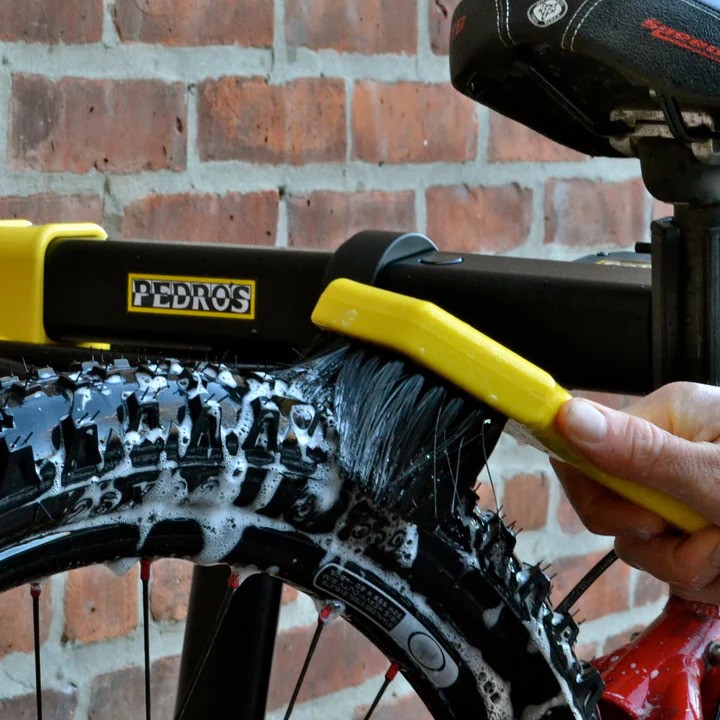
- A drivetrain degreaser applied with a brush rather than sprayed widely
- A general bike wash for frames and contact points
- A small set of high-use hand tools (hex/Torx, chain tool, tire levers)
- A chain wear gauge used on a consistent schedule
- A torque tool for stem, bar, seatpost, and brake fasteners
This setup addresses most service tasks without relying on specialized shop equipment.
Position relative to common alternatives
- Park Tool: broader tool catalog and wide availability; less emphasis on biodegradable chemistry as a central identity.
- Muc-Off: large cleaning catalog and aggressive product segmentation; tool coverage is not the core focus.
- Finish Line: strong lubricant presence with broad retail penetration; tool ecosystem is not comparable.
- Peaty’s: strong sustainability messaging and good cleaning products; smaller overall tool and kit range.
Pedro’s remains most distinctive as a mixed tool-and-chemistry brand with a long track record in both categories.
Closing Thoughts on Pedro’s
Pedro’s is not a novelty brand and does not depend on frequent redesigns to stay relevant. Its tools and chemistry products fit routine service work, and they fit riders who maintain bikes regularly rather than occasionally. For buyers choosing a maintenance system in 2026, Pedro’s is best evaluated as a practical ecosystem: durable shop-facing hand tools paired with cleaners and lubricants designed to reduce environmental impact without sacrificing basic performance.
Related Content:
- Park Tool Brand Review
- Best Helmet Guide
- Best Bike Accessory Brands
- Topeak Brand Review
- How To Lube A Bike Chain
Why Trust This Review?
BestBikeBrands is built by lifelong cyclists with decades of real-world experience — in the shop, on the trail, and behind the wrench. Our goal is simple: to help riders choose the best bikes and gear with confidence, backed by expert insights and hands-on testing. Learn more about us →