Electric bikes have changed the rules of cycling. They’re faster, heavier, and capable of covering more ground than traditional bikes ever could. That shift brings freedom—but it also raises the stakes when it’s time to slow things down.
By 2026, many e-bikes tip the scales well past 60 pounds, cruise comfortably at Class 3 speeds, and spend long stretches descending under continuous motor assistance. Braking systems that once felt “more than enough” on analog bikes can quickly feel overwhelmed here. For e-bikes, brakes aren’t just a component choice—they’re a safety system.
This guide looks at the best e-bike brake systems available in 2026, why they’re different from standard MTB brakes, and how to choose the right setup for your riding. We’ll focus on proven systems from Magura, Shimano, TRP, and SRAM—brands that design brakes with real-world e-bike demands in mind.
Why E-Bikes Push Brakes Harder
E-bike braking isn’t just “mountain biking, but heavier.” The physics are different.
- More mass
Motors and batteries can add 20–30 pounds before cargo even enters the picture. - Higher sustained speeds
Class 3 assistance keeps bikes moving near 28 mph for long stretches, not just short sprints. - Continuous load
Motor assistance reduces natural speed scrub on climbs, meaning descents start faster and stay fast. - Heat buildup
Heavier bikes + repeated braking = hot rotors, glazed pads, and fade if systems aren’t designed for it.
A standard two-piston MTB brake might stop an e-bike once. The problem comes on the second, third, or tenth hard stop—especially on long descents or in stop-and-go urban riding.
What Actually Matters in an E-Bike Brake
Marketing claims aside, a few features make the real difference.
Four-Piston Calipers
More pistons mean more pad surface area. That translates directly into power, control, and heat management.
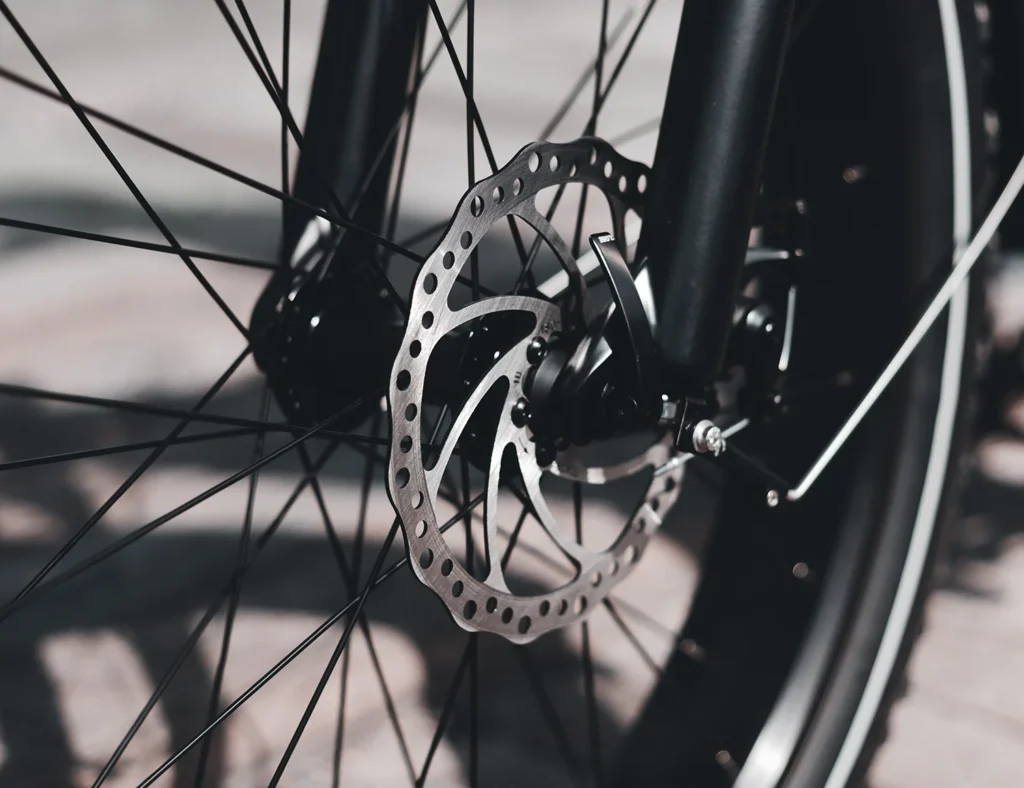
Large Rotors (200–220 mm)
Rotor size is leverage. Bigger rotors require less hand force and shed heat faster—critical on heavy bikes.
Heat-Resistant Pads
Sintered or semi-metallic pads last longer and stay consistent under sustained braking.
Reinforced Systems
Hoses, seals, and calipers need to withstand higher pressures and repeated heat cycles.
Motor Cut-Off Compatibility
Many e-bikes rely on brake signals to disengage motor power instantly. Brake levers need to support that cleanly.
The Standout E-Bike Brake Systems of 2026
Magura MT7 Pro EVO
If there’s a reference point in e-bike braking, this is it.
Magura’s MT7 Pro EVO takes downhill-proven hardware and adapts it perfectly to heavy, fast bikes. The four-piston caliper uses individual pads per piston, improving modulation and heat control. The Carbotecture master cylinder keeps weight reasonable without sacrificing stiffness, and Magura’s Royal Blood mineral oil is famously stable and low maintenance.
On long descents, the MT7 EVO stays calm. Lever feel doesn’t wander, power doesn’t spike unpredictably, and fade is almost nonexistent when paired with Magura’s MDR-P rotors in 203 or 220 mm sizes.
Best fit: high-power e-MTBs, cargo e-bikes, riders who prioritize control over everything else.
Shimano Deore XT BR-M8120
Not flashy. Just dependable.
Shimano’s four-piston XT setup has become almost ubiquitous on e-bikes for good reason. The Servo Wave lever delivers strong initial bite without feeling grabby, while Ice-Tech pads and rotors manage heat better than most riders expect.
XT brakes don’t demand much attention. They’re quiet, predictable in the wet, and serviceable almost anywhere in the world. For commuters and touring riders, that matters as much as raw power.
Best fit: daily commuters, trekking e-bikes, riders who value global serviceability.
TRP HD-E725
Built for work, not drama.
TRP’s HD-E725 is one of the most common OEM brakes on serious commuter and cargo e-bikes, and that’s no accident. Oversized pads, four pistons, and a dedicated e-bike lever with motor cut-off make it a practical choice for riders who brake often and hard.
The feel is slightly softer than Magura or SRAM, which many urban riders actually prefer. Noise is minimal, pad life is excellent, and maintenance is straightforward.
Best fit: urban commuters, delivery bikes, family and cargo e-bikes.
SRAM DB8
SRAM’s most e-bike-friendly brake yet.
The DB8 borrows caliper architecture from SRAM’s downhill lineage but ditches DOT fluid in favor of mineral oil. That change alone makes it more appealing to riders who don’t want the mess or maintenance complexity of DOT systems.
Power is strong, lever feel is firm, and modulation is predictable. It doesn’t have quite the refinement of Magura’s top systems, but it’s a meaningful step forward for SRAM in the e-bike space.
Best fit: performance-oriented e-MTBs, riders who want SRAM power with simpler upkeep.
Magura HS33 EVO
The outlier that still makes sense.
Disc brakes dominate for a reason—but for certain touring and hub-motor e-bikes, Magura’s hydraulic rim brake still holds value. The HS33 EVO offers massive pad contact, sealed hydraulics, and near-zero maintenance. No rotors to warp, no caliper alignment issues, no contamination worries.
It’s not for high-speed trail riding, but for long-distance touring and reliability-first commuters, it remains relevant.
Best fit: touring e-bikes, low-maintenance commuters, riders who value simplicity above all.
Rotor Size: The Most Underrated Upgrade
Rotor diameter often matters more than changing brake brands.
- 180 mm: borderline for heavier e-bikes
- 200–203 mm: the sweet spot for most e-MTBs and cargo bikes
- 220 mm: maximum torque and heat dissipation for high-speed or downhill-style riding
Moving from 180 mm to 203 mm can increase braking torque by roughly 20–30% with no change in caliper.
Brake Pad Choices That Actually Work
- Sintered (metallic): best for heavy bikes, long descents, wet conditions
- Semi-metallic: good balance of power, noise, and longevity
- Resin: quiet but short-lived—rarely ideal for e-bikes
For most e-bike riders, sintered pads are the right answer even if they’re slightly noisier.
Keeping E-Bike Brakes Happy
Heavy bikes mean more frequent checks.
- Inspect pads every ~500 miles
- Clean rotors with isopropyl alcohol only
- Bleed systems yearly (more often for aggressive e-MTB use)
- Bed in new pads properly—don’t skip this step
- Upgrade rotor size before blaming the caliper
Good brakes don’t just feel better—they last longer when treated correctly.
Choosing the Right System for Your Ride
- Maximum control & descending confidence: Magura MT7 Pro EVO
- Reliable, anywhere-serviceable setup: Shimano XT M8120
- Urban durability & value: TRP HD-E725
- Strong power with simpler maintenance: SRAM DB8
- Minimal fuss touring: Magura HS33 EVO
Where E-Bike Braking Is Headed
Looking ahead, braking systems are becoming more integrated:
- smarter communication between brakes and motors
- wider use of regenerative braking on hub-motor platforms
- better heat-dissipating rotor alloys
- quieter pad compounds that still handle heavy loads
The direction is clear: brakes are no longer just stopping devices—they’re becoming part of the overall control system.
A Practical Way to Think About E-Bike Brakes
Speed is fun. Torque is addictive. But confidence comes from knowing you can stop—every time, not just once.
The best e-bike brakes don’t feel dramatic. They feel calm, consistent, and predictable when the bike is heavy, fast, and fully loaded. Whether you’re commuting at 28 mph or dropping into a long mountain descent, that confidence is what turns power into enjoyment.
Choose accordingly, and your e-bike will feel like what it should be: capable, controlled, and ready for whatever the road—or trail—throws at you.
Related Content:
- Best E-Bike Brake Systems
- Shimano Brand Review
- SRAM Brand Review
- Magura Brakes Review
- Best Bike Chain Lube
Why Trust This Guide?
BestBikeBrands is built by lifelong cyclists with decades of real-world experience — in the shop, on the trail, and behind the wrench. Our goal is simple: to help riders choose the best bikes and gear with confidence, backed by expert insights and hands-on testing. Learn more about us →