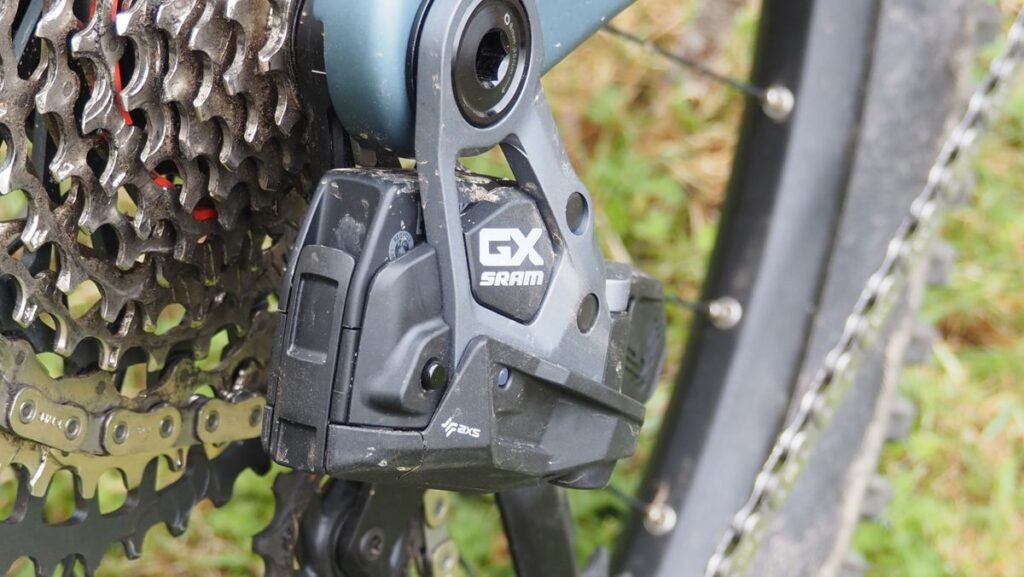
SRAM GX Eagle Transmission represents the first widely accessible implementation of SRAM’s hangerless, frame-mounted drivetrain architecture. It applies the same structural principles introduced with XX SL, XX, and X0 Transmission groups, but with materials, finishes, and pricing aligned to sustained trail and enduro use rather than weight optimization.
The system replaces the traditional derailleur hanger interface with a direct, axle-referenced mount. Shifting behavior, derailleur alignment, and impact resistance are all determined by the frame interface rather than adjustable hardware. GX Transmission maintains full wireless AXS control and load-tolerant shifting while prioritizing durability and service life over minimum mass.
This document describes how GX Eagle Transmission is constructed, how it differs from previous Eagle drivetrains, how it performs in practical riding conditions, and where it fits within SRAM’s drivetrain hierarchy.
System Definition and Scope
GX Eagle Transmission is part of SRAM’s T-Type drivetrain family. It is not a revision of existing Eagle systems and should be treated as a separate drivetrain standard.
Key defining characteristics:
- Direct frame-mounted derailleur (no hanger)
- Axle-referenced alignment
- Cassette and derailleur designed as a single mechanical system
- Wireless electronic actuation (AXS)
- Frame compatibility limited to UDH-equipped designs
GX Transmission is intended for trail, enduro, and aggressive all-mountain use where drivetrain alignment stability and impact resistance are prioritized.
Component Architecture
A complete GX Eagle Transmission system consists of the following Transmission-specific components:
- GX Eagle T-Type rear derailleur
- GX Eagle Transmission cassette (10–52T)
- GX Eagle T-Type chain
- GX crankset with T-Type chainring
- AXS Pod Controller
- AXS derailleur battery
Components outside this list are not guaranteed to function correctly. Cross-compatibility with pre-Transmission Eagle parts is limited.
Hangerless T-Type Interface
Mounting Method
GX Transmission eliminates the derailleur hanger entirely. The derailleur mounts directly to the frame via the Universal Derailleur Hanger (UDH) interface, clamping around the rear axle.
Alignment is determined by:
- Rear axle position
- Frame dropout geometry
- Factory-defined reference points
There are no derailleur limit screws in the traditional sense, and hanger alignment is no longer a tuning variable.
Mechanical Implications
- Reduced alignment variability between frames
- Lower sensitivity to minor impacts
- Consistent derailleur-to-cassette positioning
- Elimination of hanger-induced flex under load
If a frame does not support the UDH standard, GX Transmission cannot be installed.
Shifting Under Load
Transmission systems are designed to shift while torque is applied to the drivetrain. This is achieved through coordinated cassette tooth profiling, chain design, and derailleur movement timing.
In practice, this allows:
- Gear changes during steep climbs without unloading pedals
- More predictable shifts in technical terrain
- Reduced hesitation when shifting under partial or full rider input
This does not eliminate mechanical limits. Abrupt or abusive shifting under maximum torque can still accelerate wear. However, compared to traditional derailleur systems, load tolerance is significantly improved.
Derailleur Construction and Materials
GX Transmission uses more aluminum and steel than higher-tier Transmission models.
Characteristics:
- Increased impact resistance
- Higher overall mass
- Lower replacement cost relative to XX and X0
The derailleur body is designed to absorb impacts through the frame interface rather than deflecting through a hanger. Pivot hardware and bearings are sized for sustained off-road use.
Wireless Control and AXS Integration
GX Transmission uses SRAM’s AXS wireless protocol.
Pod Controller
- Button-based actuation
- Configurable via AXS mobile application
- Ambidextrous mounting options
- Consistent tactile feedback
Power Management
- Rear derailleur powered by removable AXS battery
- Controller powered by coin cell battery
- Battery compatibility shared across AXS ecosystem
Loss of power results in the drivetrain remaining in its last selected gear.
Cassette and Chain System
Cassette
- 10–52T gear range
- XD driver body required
- Transmission-specific tooth profiles
- Designed to accept controlled chain movement under load
Chain
- T-Type chain is wider and stiffer than previous Eagle chains
- Optimized for cassette interface and derailleur motion
- Not compatible with non-Transmission drivetrains
The cassette and chain function as a matched system. Substituting components compromises shift accuracy and durability.
Installation and Setup
Requirements
- Frame with UDH interface
- XD-compatible rear hub
- Transmission-compatible crankset and chainring
Setup Characteristics
- No traditional B-screw adjustment
- No hanger alignment
- Positioning based on frame reference points
Once installed correctly, the system typically requires fewer post-setup adjustments than mechanical drivetrains.
On-Trail Behavior
Shift Consistency
Shifts are consistent across cassette positions. Derailleur movement is controlled and repeatable, independent of minor frame or wheel alignment variations.
Noise and Chain Control
- Low operational noise under steady load
- Reduced chain slap due to controlled derailleur movement
- High chain retention with appropriate chainring and clutch engagement
Impact Resistance
GX Transmission tolerates minor rock strikes and side impacts better than hanger-based systems. Severe impacts can still damage components, but failure modes are more predictable.
Weight Considerations
GX Transmission is heavier than XX, XX SL, and many mechanical drivetrains.
Weight trade-offs include:
- Increased material thickness
- Steel hardware components
- Reinforced derailleur structure
For trail and enduro use, the weight increase is typically offset by stability and durability benefits.
Maintenance and Service
Routine Maintenance
- Standard drivetrain cleaning procedures apply
- Chain lubrication intervals similar to other 12-speed systems
- No hanger alignment checks required
Wear Components
- Chain and cassette wear follow normal 12-speed patterns
- Derailleur pivots and bearings are not user-serviceable
- Electronic components require periodic battery replacement
Position Within SRAM’s Lineup
GX Transmission sits below X0 and XX Transmission in price and weight, but shares the same functional architecture.
Relative positioning:
- GX: durability-focused, trail-oriented
- X0: lighter materials, premium finishes
- XX / XX SL: weight-optimized, race-focused
Performance differences on trail are minimal. The primary distinctions are mass, cost, and impact tolerance.
Intended Use Profile
GX Eagle Transmission is suited for:
- Trail and enduro riding
- Riders prioritizing shift reliability over minimum weight
- Frames built around the UDH standard
- Riders transitioning from mechanical Eagle systems
It is less suitable for:
- Frames without UDH compatibility
- Weight-critical XC race builds
- Riders seeking low-cost drivetrain solutions
System Characteristics Summary
- Direct frame-mounted derailleur
- Wireless electronic shifting
- High load-shift tolerance
- Reduced sensitivity to misalignment
- Increased mass relative to mechanical systems
- Limited backward compatibility
GX Eagle Transmission represents a structural change in drivetrain design rather than an incremental upgrade. Its benefits are most apparent in technical terrain and sustained use environments where traditional hanger-based systems show limitations.
FAQ: SRAM GX Eagle Transmission
Do I need a UDH frame to run GX Transmission?
Yes. All Eagle Transmission groups, including GX, require a frame with a UDH (Universal Derailleur Hanger) interface. Without it, the direct-mount T-Type derailleur cannot be installed.
Can I mix GX Transmission with older 12-speed Eagle parts?
Not really. Transmission (T-Type) components are designed as a system. The T-Type chain, cassette, and derailleur work together and are not intended to be mixed with earlier Eagle cassettes or derailleurs.
Is GX Transmission worth upgrading from mechanical Eagle?
If you value wireless shifting, more consistent performance, easier setup, and better shifting under load, yes — especially if you ride technical trails or long, steep climbs. If you’re budget-limited and fine with mechanical performance, you might stick with cable for now.
How much heavier is GX Transmission compared to XX or XO?
GX is heavier, but the difference is usually a few hundred grams across the whole group. For trail and enduro riders, the added durability often outweighs the weight penalty.
Can I race with GX Transmission?
Yes. While XX and XX SL are more race-focused, GX Transmission is perfectly capable for racing, especially in enduro, marathon, or rough XC where reliability is critical.
Is GX Transmission good for e-MTBs?
Yes. The robust construction, direct-mount design, and shifting under load align well with e-MTB demands, provided the frame is UDH-compatible and approved for T-Type.
How long does the AXS battery last in GX Transmission?
Battery life depends on usage, but many riders get 20–40 hours of ride time per charge. It’s always wise to keep a spare AXS battery in your pack.
Is setup easier than mechanical drivetrains?
Once the frame and components are compatible and installed, setup is generally easier and more repeatable than mechanical systems because there’s no cable tension to dial in and the frame interface sets alignment.
Is GX Transmission overkill for casual riders?
It depends on your priorities and budget. If you value wireless simplicity, extremely clean shifting, and long-term reliability — and can afford it — it’s not overkill. If you’re more price-sensitive, mechanical groups still offer excellent performance.
Related Content:
- How To Adjust Your Gears
- Best Chain Wear Tools
- Shimano Brand Review
- SRAM vs Shimano
- Best Bike Chain Lube
Why Trust This Review?
BestBikeBrands is built by lifelong cyclists with decades of real-world experience — in the shop, on the trail, and behind the wrench. Our goal is simple: to help riders choose the best bikes and gear with confidence, backed by expert insights and hands-on testing. Learn more about us →