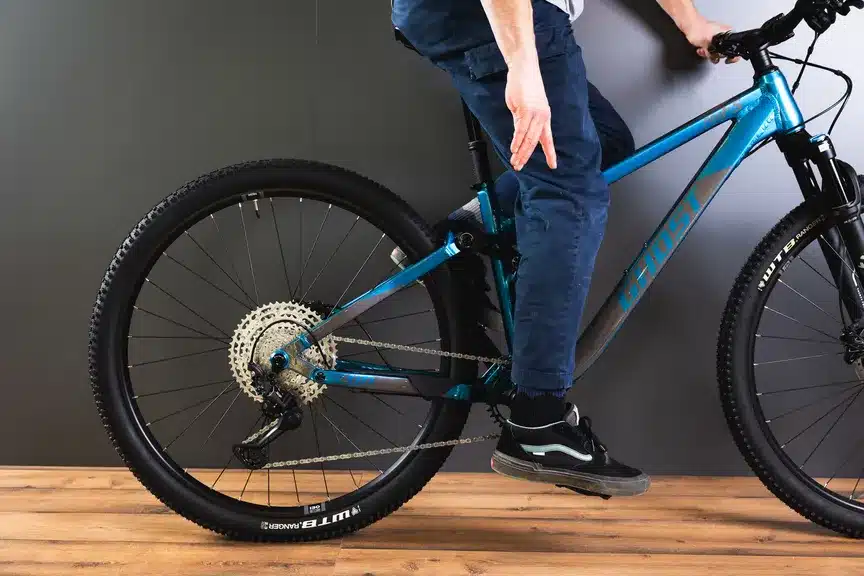
Bike sizing affects comfort, efficiency, handling, and long-term joint health. It is not a secondary consideration and it is not solved by height alone. A frame that is too small concentrates weight and restricts movement. A frame that is too large reduces control and stability. Both lead to discomfort and poor riding habits.
Sizing mistakes are common because brands use different geometry standards, online charts are simplified, and many riders never look beyond the stated frame size. This guide explains how sizing actually works in 2026: how to measure yourself, how to read geometry numbers, and how sizing differs by bike category.
The goal is not a perfect theoretical fit. The goal is a frame that gives you usable adjustment range and predictable handling.
Why Bike Fit Matters
Correct sizing influences four things directly:
- Comfort over time
- Pedaling efficiency
- Joint and soft tissue stress
- Control at speed and under load
Poor fit often shows up as knee pain, lower back fatigue, numb hands, or shoulder tension. These issues usually come from saddle height, reach, or stack being wrong relative to the rider—not from component quality.
Fit problems compound with mileage. Riders often adapt briefly, then ride less.
Step 1: Measuring Yourself
Before looking at any sizing chart, you need your own measurements. The most important one is inseam.
Inseam
This matters more than height.
How to measure:
- Stand barefoot against a wall
- Feet 15–20 cm apart
- Place a hardcover book firmly between your legs, spine up
- Measure from the top of the book to the floor
Record the measurement in centimeters. Repeat once or twice.
Height
Measure without shoes. Height helps narrow ranges but should never override inseam.
Torso and Arm Length (Optional)
These matter more for road, gravel, and endurance riding.
- Torso: base of throat to top of pelvis
- Arm: shoulder joint to wrist
These numbers help predict reach comfort but are secondary to frame geometry.
Step 2: Understanding Geometry Numbers
Frame size labels are shorthand. Geometry defines fit.
Key terms:
| Term | Meaning | Why it matters |
|---|---|---|
| Stack | Vertical distance from bottom bracket to head tube | Controls handlebar height |
| Reach | Horizontal distance from bottom bracket to head tube | Controls how stretched you feel |
| Top Tube (effective) | Horizontal cockpit length | Affects posture |
| Seat Tube | Frame height | Affects standover and saddle range |
| Standover | Clearance over top tube | Matters for control and safety |
Two “Medium” frames can differ by 20–30 mm in reach and still carry the same label. That difference is noticeable.
Stack and reach are the most reliable indicators of fit across brands.
Step 3: Sizing by Bike Category
Sizing conventions change by bike type. Use category-specific guidance.
Road Bikes
Usually sized in centimeters.
| Rider Height | Typical Frame |
|---|---|
| 147–155 cm | 47–49 cm |
| 157–165 cm | 50–52 cm |
| 167–175 cm | 53–55 cm |
| 178–183 cm | 56–58 cm |
| 185–191 cm | 58–60 cm |
| 193 cm+ | 61–64 cm |
Notes:
- Race geometry = longer reach, lower stack
- Endurance geometry = shorter reach, higher stack
- Two frames with the same seat tube can feel very different
Mountain Bikes
Usually sized XS–XL.
| Rider Height | Frame |
|---|---|
| 147–157 cm | XS |
| 160–168 cm | S |
| 170–178 cm | M |
| 180–185 cm | L |
| 188–196 cm | XL |
Mountain bikes tolerate sizing variation better due to droppers and wide bars. Reach and standover still matter.
Gravel Bikes
Use road sizing as a starting point.
Many riders prefer:
- Same size as endurance road bike
- One size down for technical terrain or upright posture
Check reach closely. Gravel bikes often vary more by brand.
Hybrid and Fitness Bikes
Often sized in inches.
| Rider Height | Frame |
|---|---|
| 147–157 cm | 13–14″ |
| 160–168 cm | 15–16″ |
| 170–178 cm | 17–18″ |
| 180–185 cm | 19–20″ |
| 188–196 cm | 21–22″ |
If between sizes, smaller usually offers easier control and mounting.
E-Bikes
Sizing varies widely by style.
- Step-through frames tolerate broader fit ranges
- Mid-drive bikes feel larger due to motor mass
- Hub-drive commuters often run compact
Test riding matters more with e-bikes. Weight distribution changes how a bike feels at the same size.
Kids Bikes
Sized by wheel diameter.
| Height | Wheel |
|---|---|
| 90–100 cm | 12″ |
| 105–115 cm | 16″ |
| 120–135 cm | 20″ |
| 135–150 cm | 24″ |
| 150 cm+ | 26″ / XS adult |
Do not size up for growth. Control matters more than longevity.
Step 4: Setting the Contact Points
Frame size determines the range. Fit comes from adjustment.
Saddle Height
At full pedal extension, the knee should retain slight bend.
Quick check:
- Heel on pedal at bottom stroke
- Leg straight without hip rocking
Fine tuning comes later, but this sets a safe baseline.
Saddle Fore–Aft
With pedals horizontal, the forward knee typically aligns near the pedal axle. This varies by discipline but works as a neutral starting point.
Handlebar Reach and Height
Elbows should remain soft, not locked.
Adjustments come from:
- Stem length
- Spacer stack
- Stem angle
Avoid compensating for an oversized frame with extreme stems.
Step 5: Brand Geometry Tendencies
General patterns, not rules:
| Brand | Fit tendency |
|---|---|
| Specialized | Neutral, balanced |
| Trek | Slightly compact |
| Giant | Longer reach |
| Cannondale | Taller stack |
| Santa Cruz (MTB) | Long reach, aggressive |
| Many e-bike brands | Short reach, low standover |
Always compare stack and reach numbers, not labels.
Step 6: Common Sizing Errors
- Choosing by height alone
- Ignoring reach and stack
- Running saddle too high
- Assuming one brand’s “Medium” equals another’s
- Oversizing children’s bikes
- Using extreme components to correct frame mismatch
Most persistent discomfort traces back to one of these.
Step 7: Between Sizes
When between two frames:
- Choose smaller for comfort, commuting, technical riding
- Choose larger for high-speed stability or racing
Adjustment range matters. A smaller frame can be made longer more easily than a large frame can be shortened.
Step 8: Online Fit Tools
Fit calculators are useful as cross-checks, not authorities.
They work best when:
- Geometry data is accurate
- Rider measurements are precise
Use more than one tool and compare outputs. Large discrepancies usually signal a geometry issue, not a measurement error.
Step 9: Professional Fits
A professional fit refines, not replaces, sizing.
Most sessions include:
- Dynamic saddle and cleat adjustment
- Reach and bar optimization
- Pedal stroke analysis
They are most valuable for long-distance riding and injury management.
Closing Thoughts
Bike sizing is not intuitive, but it is predictable. Measure accurately. Compare geometry, not labels. Choose a frame that leaves room for adjustment rather than forcing compensation.
A correctly sized bike does not draw attention to itself. It disappears under you.
Related Content:
Why Trust This Guide?
BestBikeBrands is built by lifelong cyclists with decades of real-world experience — in the shop, on the trail, and behind the wrench. Our goal is simple: to help riders choose the best bikes and gear with confidence, backed by expert insights and hands-on testing. Learn more about us →